 |
 |
 |
 |
 |
 |
 |
 |
 |

 |
Wine Industry Faces Major Challenge From Global Warming
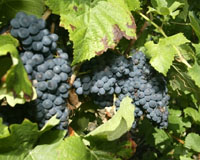
Dijon, France (AFP) April 01, 2007 A hot year is normally associated with a vintage year for wine growers but global warming could, by the end of the century, have adverse effects and already poses a major challenge to vineyards in southern France and California. "The first studies on the consequences of global warming show that warming favours the quality of the wine, said Gregory Jones, an Associate Professor of Geography at the American University of Southern Oregon. Speaking at a conference on the impact of global warming on the wine industry in this wine-making city, he continued that "in the future, warming could become disastrous in numerous regions." He said the threat might come from a series of challenges, citing problems with irrigation, diseases, and soil erosion resulting from flooding. For his part, Bernard Sequin, from the French National Institute for Agricultural Research, said: "Heat, it's sometimes a good thing, up to a certain threshold." The heatwave which hit Europe in 2003 gave some idea of what is in store in the future. "(This) was generally positive for the harvests in the north of France but less so in the south," Sequin said. The regions most threatened by global warming are those with the hottest climates, such as southern Europe and California. If nothing is done about global warming, only the coastal regions of California, cooled by the ocean breeze, will be good for cultivating vines by 2100, Jones believes. Facing this challenge, scientists and professionals from the wine industry are searching for responses. Gemma Mollevi, a specialist in Spanish vineyards, suggested planting vines shallow in the earth, to better conserve water and shade the grapes from the sun, and developing controlled irrigation. "Measures are urgently needed in the hottest and driest zones of Spain," she said. In the Bordeaux region, research is already underway, Jean-Claude Hinnewinkel, a local wine industry specialist, said. The scientific work is concentrating on how certain varieties of vines adapt to heat as well as well as counteracting the perverse effects of strong heat on the taste of the wine, which tends to be too sweet and alcohol levels can be too high. Hinnewinkel, a geography lecturer at Bordeaux University, called on the industry to adapt "rapidly" to the challenges and "rethink its organisation to adapt to this new reality."
Source: Agence France-Presse Related Links The latest farming technology and science news Farming Today - Suppliers and Technology
 EU Must Cut Tuna Fishing By Half To Save Bluefin
 Geneva (AFP) March 28, 2007
The environmental group WWF warned on Thursday that bluefin tuna stocks in the Mediterranean and east Atlantic would collapse within years unless the European Union cuts its fishing of the species by half. "There is no compromise to be had, this is a countdown to collapse," Justin Woolford, head of the WWF's European fisheries campaign, told AFP. |
|
|

| The content herein, unless otherwise known to be public domain, are Copyright Space.TV Corporation. AFP and UPI Wire Stories are copyright Agence France-Presse and United Press International. ESA Portal Reports are copyright European Space Agency. All NASA sourced material is public domain. Additional copyrights may apply in whole or part to other bona fide parties. Advertising does not imply endorsement, agreement or approval of any opinions, statements or information provided by Space.TV Corp on any Web page published or hosted by Space.TV Corp. Privacy Statement |