 |
 |
 |
 |
 |
 |
 |
 |
 |

 |
New Property Found In Ancient Mineral Lodestone
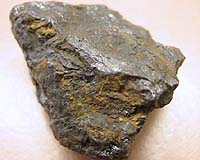
Houston TX (SPX) Dec 18, 2007 Using the latest methods for nanofabrication, a team led by Rice University physicists has discovered a surprising new electronic property in one of the earliest-known and most-studied magnetic minerals on Earth -- lodestone, also known as magnetite. By changing the voltage in their experiment, researchers were able to get magnetite at temperatures colder than minus 250 degrees Fahrenheit to revert from an insulator to a conductor. The research was published online Dec. 16 and will be included in February's print edition of Nature Materials. "It's fascinating that we can still find surprises in a material like magnetite that has been studied for thousands of years," said lead researcher Doug Natelson, associate professor of physics and astronomy. "This kind of finding is really a testament to what's possible now that we can fabricate electronic devices to study materials at the nanoscale." The magnetic properties of lodestone, also known as magnetite, were documented in China more than 2,000 years ago, and Chinese sailors were navigating with lodestone compasses as early as 900 years ago. Magnetite is a particular mineral of iron oxide. Its atoms are arranged in a crystal structure with four oxygen atoms for every three of iron, and their arrangement gives the mineral its characteristic magnetic and electrical properties. Physicists have known for more than 60 years that the electronic properties of magnetite change radically and quickly at cold temperatures. As the material cools below a critical temperature near minus 250 degrees Fahrenheit, it changes from an electrical conductor to an electrical insulator -- a electrical transformation that's akin to the physical change water undergoes when it freezes into ice. "When we applied a sufficiently large voltage across our nanostructures we found that we could kick the cooled magnetite out of its insulating phase and cause it to become a conductor again," Natelson said. "The transition is very sharp, and when the voltage is then lowered back below a lower critical value the magnetite snaps back into its insulating phase. We don't know exactly why this switching occurs, but we think further experiments will shed light on this and the nature of the insulating state." With engineers looking to exploit novel electronic materials for next-generation computers and hard drives, phase transitions between insulating and conducting states have become an increasingly hot research topic in physics and materials science in recent years. The debate about the causes and specifics of magnetite's temperature-driven phase change has simmered much longer. Natelson said physicists have long sparred about the possible underlying physical and electronic causes of the phase transition. The discovery of this new voltage-driven switching provides new clues, but more research is still needed, he said. "The effect we discovered probably wasn't noticed in the past because nanotechnology is only now making it possible to prepare the electrodes, nanoparticles, and thin films required for study with the precision necessary to document the effect," he said. Natelson's team experimented on two kinds of magnetite. One, called nanorust, consists of tiny particles of magnetite developed in the laboratory of Rice chemist Vicki Colvin, director of Rice's Center for Biological and Environmental Nanotechnology. The second, thin films of single-crystal magnetite, were produced by Igor Shvets' research group at the University of Dublin's Trinity College. These high quality materials with precise compositions were essential to the study, said Natelson. Related Links Rice University Nano Technology News From SpaceMart.com Computer Chip Architecture, Technology and Manufacture
 New Paper Reveals Nanoscale Details Of Photolithography Process
 Washington DC (SPX) Dec 13, 2007
Scientists at the National Institute of Standards and Technology (NIST) have made the first direct measurements of the infinitesimal expansion and collapse of thin polymer films used in the manufacture of advanced semiconductor devices. It's a matter of only a couple of nanometers, but it can be enough to affect the performance of next-generation chip manufacturing. |
|
|

| The content herein, unless otherwise known to be public domain, are Copyright Space.TV Corporation. AFP and UPI Wire Stories are copyright Agence France-Presse and United Press International. ESA Portal Reports are copyright European Space Agency. All NASA sourced material is public domain. Additional copyrights may apply in whole or part to other bona fide parties. Advertising does not imply endorsement, agreement or approval of any opinions, statements or information provided by Space.TV Corp on any Web page published or hosted by Space.TV Corp. Privacy Statement |