 |
 |
 |
 |
 |
 |
 |
 |

| . |  |
. |

|
|
. |

 by Staff Writers East Lansing MI (SPX) Jun 08, 2011
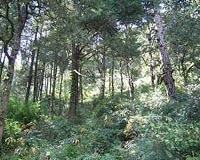
Managers of northern Michigan forests may not see the birds for the trees - or at least are in danger of losing sight of songbird neighborhoods when looking out for timber harvests. In a novel look at managing both the future's timber harvest while being mindful of the impact on key songbirds in Michigan's Upper Peninsula, Michigan State University researchers use a new forest simulation model for the first time to look at what timber-friendly hardwood regeneration can mean to bird habitat. And it's a long-range look, given that the time lag between forest management decisions and impact are generations. The results are reported in "Combined long-term effects of variable tree regeneration and timber management on forest songbirds and timber production" online in the journal Forest Ecology and Management. "Foresters are farmers - but instead of sowing and harvesting in six months, they need to think 50 years in the future," said James Millington, the paper's lead author and former post-doctoral researcher at Michigan State University's Center for Systems Integration and Sustainability (CSIS). "If you are worried about the state of the forest in 100 years time, you need to think about it now and you'll need good models like we're developing." Michigan's Upper Peninsula is home not only to a thriving timber industry, but also is an important breeding ground to many songbird species of conservation concern. Birds, Millington explained, are particular about their neighborhoods - having specific preferences for how open the forest canopy is and how high and sturdy branches are. If a forest changes considerably as it is harvested and regrows, birds won't be as successful at nesting and reproducing. Paper coauthors are Michael Walters, associate professor of forestry; Megan Matonis, who recently earned a master's degree in forestry while a CSIS member; Edward Laurent, a former CSIS doctoral student now science coordinator at the American Bird Conservancy; Kimberly Hall, climate change scientist at The Nature Conservancy; and Jianguo "Jack" Liu, Rachel Carson Chair in Sustainability and director of the center. The group engaged in a complicated birds-eye view of the forest, seeking to understand how four key songbirds - the black-throated green warbler, eastern wood-pewee, least flycatcher and rose-breasted grosbeak - dealt with neighborhood upheaval. The study area stretches over some 3,000 square miles of public and private land from Crystal Falls to the west, east and south to Escanaba and north of Marquette. For two years, the team examined the harvest gaps left in forests when hardwoods are cut down. Logging changes a forest's composition - creating gaps in the canopy that can take years to fill. Matonis, Millington's colleague, recently reported that the current popular way of encouraging regeneration of hardwoods, called gap harvesting, isn't always successful. Sometimes it appears deer are chowing on the maple seedling trying to grow in the sunny gaps left by harvest. The four songbird species the team picked all are fussy about their canopy. For example, the warbler likes its canopy dense with lots of branches about 50 feet high. The flycatcher, however, digs more open expanses. "If all the birds like the same thing - understanding consequences of logging and differences in tree regeneration would be easier," Millington said. The analysis is ambitious and complicated. The team seeks to create models that show how a forest shapes up at different rates of regeneration, both in timber-centric and bird-centric points of view. The bottom line: Regeneration in harvest gaps of species that become large canopy dominant trees such as sugar maple is crucial for forest managers to have choices. If trees aren't growing back well, there's no opportunity to even start watching out for the forest's residents. "Essentially for birds in these forests it's the density of sugar maple regeneration that has the biggest effect on their future habitat," Millington said. "These birds are picky about their overstory - and if regeneration is changing the forest now, in 100 years times your canopy is going to be very different. "We know how to grow trees pretty well and we can get timber, but people who manage timber need to talk to people who manage for wildlife, and they all need information to make decisions."
|
. |
|
| The content herein, unless otherwise known to be public domain, are Copyright 1995-2011 - Space Media Network. AFP and UPI Wire Stories are copyright Agence France-Presse and United Press International. ESA Portal Reports are copyright European Space Agency. All NASA sourced material is public domain. Additional copyrights may apply in whole or part to other bona fide parties. Advertising does not imply endorsement,agreement or approval of any opinions, statements or information provided by Space Media Network on any Web page published or hosted by Space Media Network. Privacy Statement |

 del.icio.us
 Digg
Digg Reddit
 Google