
 |
 |
 |
 |
 |
 |
 |
 |
 |

 |

Corvallis, OR (SPX) Mar 29, 2011 A prototype scanner aboard the International Space Station has been taking new images of Earth's coastal regions during the 16 months since it was launched, providing scientists with a new set of imaging tools that will help them monitor events from oil spills to plankton blooms. The images and other data are now available to scientists from around the world through an online clearinghouse coordinated by Oregon State University. Additional details of the project will be announced in a forthcoming issue of the American Geophysical Union journal, EOS, and can be found on an OSU website about the project. The Hyperspectral Imager for the Coastal Ocean, or HICO, is the first space-borne sensor created specifically for observing the coastal ocean and will allow scientists to better analyze human impacts and climate change effects on the world's coastal regions, according to Curtiss O. Davis, an OSU oceanographer and the project scientist. "What HICO does that other ocean imaging systems like NASA's MODIS cannot is provide color sensor data down to the human scale," Davis said. "Whereas the normal resolution for an ocean imager is about one kilometer, HICO provides resolution down to 90 meters. And instead of having just nine channels like MODIS, it has 90 channels. "This allows us to focus the imaging system on a section of the coastline and map the ocean floor in water as deep as 50 to 60 feet," he added. "It gives us the ability to track sediment down the Columbia River, and to distinguish that sediment from phytoplankton blooms in the ocean. It can reveal near-shore eddies, currents, and the influence of coastal streams entering the ocean. "It is a scientific treasure trove for the coastal oceanographer," he added. This sophisticated imaging system was developed by the Naval Research Laboratory and installed aboard the space station in 2009. Its development was an experiment - to see if engineers could create an "Innovative Naval Prototype" instrument very quickly, at low-cost, and make it work for a year, said Davis, who worked for several years at the laboratory before joining the OSU faculty. That first goal was achieved last October and now the focus is on the second goal, conducting useful science with this unique data set. "We've already talked to 40-50 interested scientists and shared some preliminary data," he said, "and they've been excited about the potential. They all want a piece of it." Some of the images HICO has provided have revealed interesting data: Images of the Han River in South Korea outline the dynamic, rapidly shifting shallow mud flats that are covered by the incoming tide, but include sandbars where boats can easily get mired; Images from the Straits of Gibraltar, separating Spain from North Africa, reveal where large internal waves propagate hundreds of feet below the surface. These waves, which were used during World War II to hide submarines moving through the channel, can affect fishing and boat navigation. Images of the Columbia River, taken during a large storm and after, reveal changing breakwaters and bars that demonstrate the complexity and dynamics of this large system. "We hope to begin imaging the area around Sendai, Japan, which was devastated by the recent earthquake and tsunami to see what we might learn," Davis said. The space station orbits Earth about 16 times a day and the researchers are able to get about 5-6 good images daily of targeted locations. Cloud cover and darkness limit the number of possible images, and the transmission of data files is enormous. Jasmine Nahorniak, a senior research assistant, developed and runs the website through OSU's College of Oceanic and Atmospheric Sciences where HICO images and other data are stored and shared with scientists around the world. "We have a couple of thousand images and a growing number of scientists who are interested in the data," she said. "It's a work in progress."
Share This Article With Planet Earth
Related Links HICO website Station at NASA Station and More at Roscosmos S.P. Korolev RSC Energia Watch NASA TV via Space.TV Space Station News at Space-Travel.Com

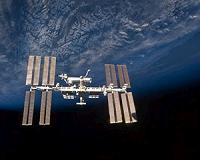 Data Streaming In From ISS To OSU Lab
Corvallis OR (SPX) Mar 25, 2011 A prototype scanner aboard the International Space Station has been taking new images of Earth's coastal regions during the 16 months since it was launched, providing scientists with a new set of imaging tools that will help them monitor events from oil spills to plankton blooms. The images and other data are now available to scientists from around the world through an online clearinghouse ... read more |
|
|
| The content herein, unless otherwise known to be public domain, are Copyright 1995-2010 - SpaceDaily. AFP and UPI Wire Stories are copyright Agence France-Presse and United Press International. ESA Portal Reports are copyright European Space Agency. All NASA sourced material is public domain. Additional copyrights may apply in whole or part to other bona fide parties. Advertising does not imply endorsement,agreement or approval of any opinions, statements or information provided by SpaceDaily on any Web page published or hosted by SpaceDaily. Privacy Statement |


 del.icio.us
 Digg
Digg Reddit
 YahooMyWeb
 Google
 Facebook


