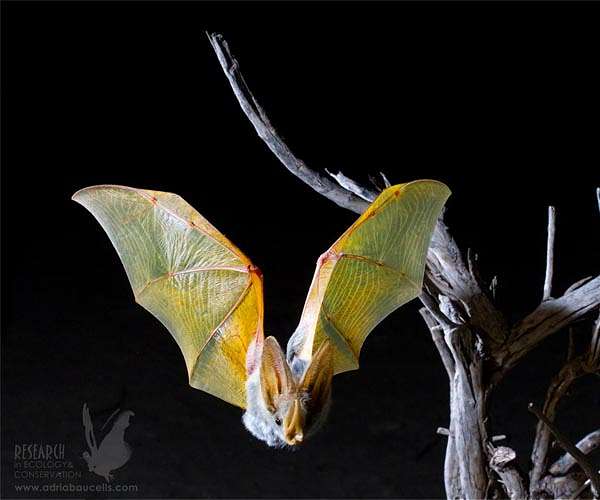
A new study has resolved how wild bats navigate complex environments in complete darkness by showing they regulate their flight using a form of acoustic flow, offering fresh insight into biosonar and potential applications for autonomous navigation systems. The research, led by the University of Bristol, appears in Proceedings of the Royal Society B and addresses how bats manage thousands of overlapping echoes when flying through cluttered habitats such as hedgerows and forests.
Bats hunting at night rely on echolocation to detect and track objects, emitting calls and analysing returning echoes to build a representation of their surroundings. In complex habitats, a single call produces echoes from many objects at different distances and directions, making it impractical for bats to inspect each echo individually, so researchers have proposed that they instead use broader patterns in the echo field as a navigational cue.
The team investigated the idea that bats exploit acoustic flow velocity, a property of the echo scene that changes with both the animal's speed and the distance to surrounding structures. Acoustic flow is analogous to the visual flow that humans experience when moving through the world, where nearby objects appear to move faster across the visual field than distant ones as speed increases, and the researchers hypothesised that bats may use equivalent patterns in echo timing and frequency to control their motion.
To test this hypothesis, aerospace engineers and biologists at Bristol built a custom bat accelerator machine, an eight metre flight corridor lined with revolving hedge like panels. These panels carried around 8,000 acoustic reflectors acting as artificial leaves, chosen and arranged to mimic the dense, complex echoes produced by a real hedge so that the team could systematically manipulate the acoustic conditions that bats experience in flight.
Over three nights, the researchers recorded 181 flight trajectories from free ranging pipistrelle bats interacting with the corridor. Of these, they analysed 104 flights in which individual bats traversed at least the full eight metre test section, ensuring that each trajectory included a substantial segment of controlled acoustic flow conditions.
During the experiments, the team altered the motion of the reflector panels to change the acoustic flow speed relative to the bats' forward motion. When the reflectors moved against the bats' direction of travel, effectively increasing the acoustic flow speed that the animals would perceive, the bats responded by flying significantly more slowly, reducing their speed by up to 28 percent relative to the induced change in acoustic flow conditions.
When the reflectors moved in the same direction as the bats, thereby reducing the acoustic flow speed, the bats showed the opposite response and accelerated along the corridor. These behavioural adjustments indicate that bats are sensitive to systematic changes in the Doppler shifts and timing patterns that characterise acoustic flow and that they use these changes as a feedback signal to regulate their own flight speed within cluttered environments.
The findings support the conclusion that echolocating bats use Doppler based acoustic flow as a core mechanism for speed control and navigation in complex habitats. By demonstrating that bats adjust their flight in line with artificial manipulations of acoustic flow, the study provides evidence that they rely on global properties of the echo field, rather than analysing every single echo separately, to maintain precise control while flying in darkness.
The work also highlights an opportunity to transfer biological principles of navigation into engineered systems. By incorporating acoustic flow based control strategies into drones or other autonomous vehicles, designers may enable machines to navigate safely and efficiently through cluttered or GPS denied environments using sound, in a similar way to how bats move through hedges and forests at night.
Lead author Athia Haron from Bristol's School of Civil, Aerospace and Design Engineering noted that the results reveal how bats exploit their sensory system at a systems level to solve a complex control problem. Co author Marc Holderied from the School of Biological Sciences emphasised that the study links sensory biology and flight behaviour by showing how the structure of echoes across space and time informs movement decisions.
Co author Shane Windsor of the School of Civil, Aerospace and Design Engineering added that the bat accelerator experiment demonstrates how changing the apparent motion of the acoustic scene can tune bat speed, making them fly even faster or slower depending on the direction of reflector motion. The authors suggest that this controlled manipulation of acoustic environments offers a powerful tool for probing how animals integrate sensory information to guide movement.
Research Report:Acoustic flow velocity manipulations affect the flight velocity of free-ranging Pipistrelle bats