 |
 |
 |
 |
 |
 |
 |
 |
 |

 |
A Year Of In-Orbit Experience For Galileo Rubidium Clocks
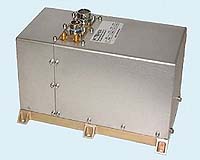
Paris, France (ESA) May 22, 2007 Europe's first satellite-borne rubidium clocks have been in orbit for over a year. There is good news for the building of the Galileo system: the results obtained from GIOVE-A's first year of operations show performance that is largely in line with the specifications. GIOVE-A, the first Galileo in-orbit validation element, was launched on 28 December 2005. One of its two rubidium clocks was switched on for the first time on 10 January 2006 and Galileo signals were transmitted two days later. The timekeeping of the clocks on the Galileo spacecraft will play an important role in determining the overall accuracy of the system, so evaluation of their performance is a crucial part of the Galileo in-orbit verification process.
Indirect measurement The technique used to characterise clock performance is known as Orbit Determination and Time Synchronisation (ODTS). ODTS is a statistical method which takes the Galileo and GPS data, together with the laser ranging data, and calculates spacecraft orbits, clock times, the effects of the Earth's atmosphere on the radio signals and the delays in the receiving systems. The precision of the calculations is so great that even the tiny orbit disturbances caused by the pressure of sunlight shining on the satellites is taken into account. The ground systems cannot measure the 'pure' clock performance on-board GIOVE-A. The 'apparent' clock performance observed on the ground is seen through the satellite signal generation chain, the radio transmission path through space, the receiver network and the algorithm used to perform the performance estimation.
Performance to date The measured performance of the clocks meets the specification over short and medium timescales. A few 'jumps' in clock frequency have been observed, which impact the long term accuracy. Such frequency changes are a well known phenomenon in rubidium clock technology but their cause is not yet well understood. Their effect on GPS performance has already been analysed and corrective measures proposed. The Galileo team are ground testing a number of improvements to the clock design which are intended to minimise both the occurrence and size of the jumps. Galileo is a joint initiative between ESA and the European Commission. When fully deployed in the early years of the next decade, it will be the first civilian positioning system to offer global coverage. Related Links GIOVE website European GNSS Supervisory Authority Galileo at EU Understanding Time and Space
 Atomic Clock Signals May Be Best Shared By Fiber-Optics
 Boulder CO (SPX) Mar 06, 2007
Time and frequency information can be transferred between laboratories or to other users in several ways, often using the Global Positioning System (GPS). But today's best atomic clocks are so accurate-neither gaining nor losing one second in as long as 400 million years-that more stable methods are needed. |
|
|

| The content herein, unless otherwise known to be public domain, are Copyright Space.TV Corporation. AFP and UPI Wire Stories are copyright Agence France-Presse and United Press International. ESA Portal Reports are copyright European Space Agency. All NASA sourced material is public domain. Additional copyrights may apply in whole or part to other bona fide parties. Advertising does not imply endorsement, agreement or approval of any opinions, statements or information provided by Space.TV Corp on any Web page published or hosted by Space.TV Corp. Privacy Statement |