 |
 |
 |
 |
 |
 |
 |
 |
 |

 |
Pioneering Galileo Satellite Begins Third Year In Orbit
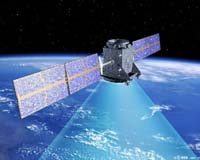
Guildford, UK (SPX) Jan 03, 2008 The first satellite in Europe's Galileo satellite navigation programme has achieved two years of highly successful in-orbit operation. GIOVE-A secured a crucial Galileo frequency filing with the International Telecommunications Union (ITU) and supported the development and validation of technology crucial to the future of Galileo. The 660kg satellite was developed by SSTL for the European Space Agency (ESA) to broadcast Galileo signals from space and claim the frequencies filed with the ITU for Europe. SSTL designed, built and tested the first Galileo satellite through a rapid (30 month) development programme and within a 28 million Euro budget, and launched the satellite on schedule on 28th December 2005. Just 15 days later, at 17:25 GMT on the 12 January 2006, the first Galileo signals were transmitted from the satellite. By March the same year, ESA was able to confirm that it had brought the Galileo-related frequency filings into use, three months ahead of the official ITU deadline. Since then, ESA has built up the GIOVE Mission Segment, comprising Galileo Experimental Sensor Stations (GESS) distributed world-wide and the GIOVE Processing Centre, to track the GIOVE A navigation signals to generate orbit models and produce navigation messages. This has enabled ESA to check both the instruments on-board the satellite and the receivers on the ground and tests have confirmed the success of the mission. GIOVE-A has also assisted clock characterisation experiments that enabled ESA to test the performance of the satellite's state-of-the-art onboard rubidium atomic frequency clock. Initial results demonstrated the clocks to be highly accurate, proving technology that will be integral to all future Galileo satellites. This small SSTL satellite is a pioneer - not only for its payload's importance to Galileo but also for its Medium Earth Orbit (MEO) location. Andy Bradford, SSTL's Engineering Director, recalls, "European scientists possessed scant information about this new operating environment. We knew very little about the effects of radiation in this orbit and the design and protection of the satellite was a significant engineering challenge. The knowledge and experience gained first-hand from this successful mission is significant for the development of future SSTL missions beyond LEO." Operating at 23,258 km, GIOVE-A has proven reliable and gathered important data about the MEO environment for use in future Galileo missions. On the 5th March ESA awarded a second contract to SSTL for initial activities leading to the construction of a further spacecraft for the Galileo satellite navigation system. Named GIOVE-A2, the new satellite (estimated total value 25 to 30 million Euros) is based on the Company's proven GIOVE-A technology. The intention is to provide a follow-on mission to ensure signal continuity. The next phase in Galileo has recently been confirmed with a financing package of 3.4 billion Euros agreed by the European Union. This requires a constellation of 30 satellites and an associated worldwide network of ground stations to be deployed by 2013. SSTL hopes to put the knowledge and technology developed through GIOVE-A and GIOVE-A2 into practice in the next phase. On the 4th December SSTL signed a Memorandum of Understanding (MOU) with German satellite manufacturer, OHB Technology AG, signalling their willingness to bid together for Galileo satellite contracts. Related Links Surrey Satellite Technology Limited GPS Applications, Technology and Suppliers
 Two Years In Space For Galileo Satellite
 Paris, France (SPX) Dec 20, 2007
On 28 December, it will be two years since GIOVE-A - the first Galileo satellite - was launched by a Soyuz rocket from Baikonur, in Kazakhstan. This satellite demonstrates the progress Europe has made in setting up its own navigation system. Since January 2006, Galileo signals have been broadcast by GIOVE-A, and received all around the globe. |
|
|

| The content herein, unless otherwise known to be public domain, are Copyright Space.TV Corporation. AFP and UPI Wire Stories are copyright Agence France-Presse and United Press International. ESA Portal Reports are copyright European Space Agency. All NASA sourced material is public domain. Additional copyrights may apply in whole or part to other bona fide parties. Advertising does not imply endorsement, agreement or approval of any opinions, statements or information provided by Space.TV Corp on any Web page published or hosted by Space.TV Corp. Privacy Statement |