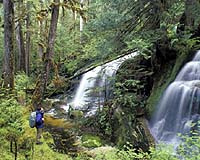
Once the display-house prototype is tested and customized, at least two sites are to be fully deployed in the fall, one likely in the Brazilian rainforest, and the other in a forest in Panama.
Once the display-house prototype is tested and customized, at least two sites are to be fully deployed in the fall, one likely in the Brazilian rainforest, and the other in a forest in Panama. |
The research team, including Pawel Gburzynski, Mario Nascimento, and Arturo Sanchez-Azofeifa, recently launched EcoNet, a functional model of a WSN for environmental monitoring in the display house in the University of Alberta's Agriculture/Forestry Centre.
The display house hosts a small but feature-rich environment that mimics that of a tropical forest. Using a WSN, a number of sensors can continuously monitor factors like temperature and luminosity and will process, store and transmit data co-operatively and wirelessly with other sensors to generate data that can then be collected and made available to users virtually anywhere on the globe.
The sensors represent a technology for researchers to monitor diverse phenomena continuously and inconspicuously.
Having the data continuously monitored by researchers substantially increases the chances of uncovering anomalies early enough to investigate them promptly and thoroughly.
The overall framework of WSN can also be extended for use in other closely related scenarios such as monitoring potentially dangerous situations like hazardous waste disposal, or hard-to-witness phenomena such as ice cap movements in the Arctic.
The opportunities these sensors will provide to scientists are paramount in a global environment that is changing at an ever-increasing pace.
Once the display-house prototype is tested and customized, at least two sites are to be fully deployed in the fall, one likely in the Brazilian rainforest, and the other in a forest in Panama.
Related Links
 AIAA Honors Lockheed Martin GPS IIR-M Team With 2008 Space Systems Award
 Newtown PA (SPX) Jun 09, 2008
| The content herein, unless otherwise known to be public domain, are Copyright Space.TV Corporation. AFP and UPI Wire Stories are copyright Agence France-Presse and United Press International. ESA Portal Reports are copyright European Space Agency. All NASA sourced material is public domain. Additional copyrights may apply in whole or part to other bona fide parties. Advertising does not imply endorsement, agreement or approval of any opinions, statements or information provided by Space.TV Corp on any Web page published or hosted by Space.TV Corp. Privacy Statement |