 |
 |
 |
 |
 |
 |
 |
 |
 |

 |
New Glonass Satellites Due To Operate For Seven Years
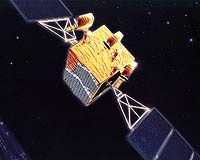
Krasnoyarsk (RIA Novosti) Dec 28, 2007 The three Glonass-M navigation satellites that Russia launched on Tuesday will be operational for seven years, a design and production bureau spokesman said on Wednesday. The three satellites were launched from the Baikonur space center in Kazakhstan on board an improved Proton-M carrier rocket to join the existing satellite constellation, which comprises 15 operational satellites. "The equipment of each of the satellites has a seven-year active lifetime," a spokesman from the Applied Mechanics Scientific Production Association said. Glonass (Global Navigation Satellite System) is the Russian equivalent of the U.S. Global Positioning System (GPS), which is designed for both military and civilian use, and allows users to identify their positions in real time. The spokesman said the navigation accuracy properties of the three new satellites were much better than those possessed by the system's first satellites. A fully operational Glonass constellation will consist of 24 Glonass-M and Glonass-K satellites by 2010, with 21 used for transmitting signals and three for on-orbit spares, deployed in three orbital planes. A total of 9.88 billion rubles ($380 million) was allocated for Glonass from the federal budget in 2007, and 4.7 billion ($181 million) in 2006. Sergei Ivanov, Russia's first deputy prime minister, said on Monday that with the addition of three satellites the Glonass system would consist of 18 satellites and would be capable of providing navigation and positioning data covering the whole territory of the Russian Federation. Another six satellites will be added to the Glonass system in 2008, and the first two improved Glonass-K satellites are set to be launched in 2009. The future modification, Glonass-K, is an entirely new model based on a non-pressurized platform, standardized to the specifications of the previous models' platform, Express-1000.
Source: RIA Novosti News Agency Related Links GPS Applications, Technology and Suppliers
 Glonass For Cars Shown To Putin And Security Council
 Moscow (RIA Novosti) Jan 03, 2008
Putin and members of Russia's Security Council were given a demonstration of a Glonass device for cars at a meeting on foreign and domestic policy on Saturday, the presidential press secretary said. Glonass (Global Navigation Satellite System) is the Russian equivalent of the U.S. Global Positioning System (GPS), which is designed for both military and civilian use, and allows users to identify their positions in real time. |
|
|

| The content herein, unless otherwise known to be public domain, are Copyright Space.TV Corporation. AFP and UPI Wire Stories are copyright Agence France-Presse and United Press International. ESA Portal Reports are copyright European Space Agency. All NASA sourced material is public domain. Additional copyrights may apply in whole or part to other bona fide parties. Advertising does not imply endorsement, agreement or approval of any opinions, statements or information provided by Space.TV Corp on any Web page published or hosted by Space.TV Corp. Privacy Statement |