Cornell's CUSat was chosen in March 2007 as the winner of the University Nanosatellite Program's Nanosat-4 competition, sponsored by the U.S. Air Force and the American Institute of Aeronautics and Astronautics.
Cornell's CUSat was chosen in March 2007 as the winner of the University Nanosatellite Program's Nanosat-4 competition, sponsored by the U.S. Air Force and the American Institute of Aeronautics and Astronautics. |
Cornell has built the pair of satellites with funding from the Air Force's University Nanosatellite Program. If chosen from among the finalists, CUSat will be the first spacecraft launched by the U.S. Department of Defense's newly formed Operationally Responsive Space (ORS) office. ORS's Jumpstart mission aims to demonstrate the ability to rapidly integrate and execute a mission, from initial call-up to launch.
The decision to send the Cornell satellite, or one of the two other finalists - the Air Force Research Laboratory's Plug and Play satellite with multiple payloads or SpaceDev's Trailblazer - will be made before the scheduled SpaceX flight readiness review, about two weeks before launch.
Space Exploration Technologies Corp. will carry the first Jumpstart mission payload aboard the Falcon 1 Flight 003 vehicle.
Cornell's CUSat was chosen in March 2007 as the winner of the University Nanosatellite Program's Nanosat-4 competition, sponsored by the U.S. Air Force and the American Institute of Aeronautics and Astronautics. At last year's competition, Cornell's satellite was chosen from among 11 entries by a panel of government and industry judges based on student participation, the flight-worthiness of the design and relevance of the mission to the Air Force.
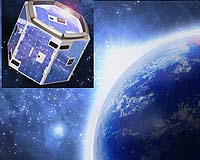
CUSat is actually two identical satellites built into a hexagonal package weighing about 90 pounds. Once in orbit, the two satellites will separate and navigate around each other about 10 yards apart. Using highly refined global positioning system (GPS) measurements, one satellite will relay pictures of the other to the Mission Control Center in Ithaca, where a three-dimensional virtual model of the target satellite will then be constructed. Such a system could be used to diagnose problems with future spacecraft, including examination of tiles on the space shuttle.
Mason Peck, a Cornell assistant professor of mechanical and aerospace engineering, is the principal investigator for the project and serves as the faculty advisor to the student team. CUSat uses algorithms developed by Mark Psiaki, associate professor of mechanical and aerospace engineering, and his Ph.D. student Shan Mohiuddin, that provide accuracy down to a fraction of an inch.
Peck credits Professor Mark Campbell with the design of the satellite's thrusters, which burn solid Teflon, a much safer system than compressed gas or combustible propellant. Alumnus Kris Young, M.Eng. '07, was the student program manager during the flight competition review. Rob Zimmerman, M. Eng. 08, now leads the team.
About 80 students have worked on the project, but about 225 have been involved since 2005 when CUSat began.
Related Links
 Garmin Simplifies Searching, Sending And Navigating To Locations Through Google Maps
 Las Vegas NV (SPX) Apr 03, 2008
| The content herein, unless otherwise known to be public domain, are Copyright Space.TV Corporation. AFP and UPI Wire Stories are copyright Agence France-Presse and United Press International. ESA Portal Reports are copyright European Space Agency. All NASA sourced material is public domain. Additional copyrights may apply in whole or part to other bona fide parties. Advertising does not imply endorsement, agreement or approval of any opinions, statements or information provided by Space.TV Corp on any Web page published or hosted by Space.TV Corp. Privacy Statement |